A Story That Made Me Smile
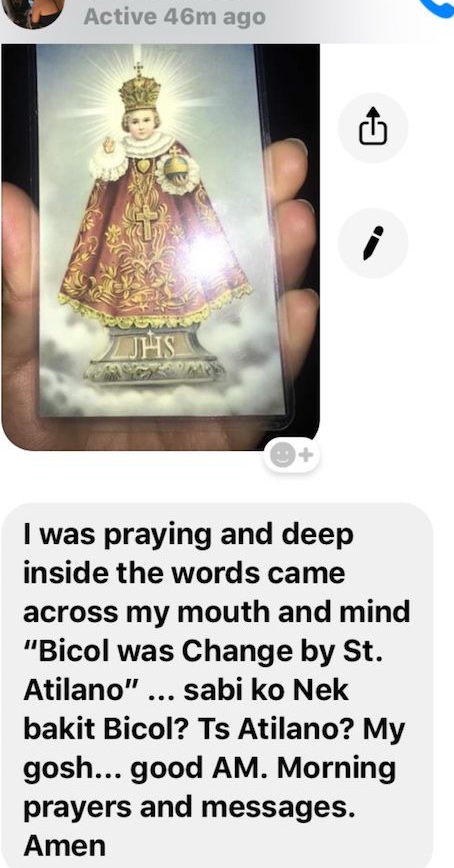
In June 2019, my friend Gee sent me a message after prayer. She said that the words “Bicol was changed by St. Atilano” had come to her, and then she asked me, “Is Atilano a saint?” I did not know what to make of it. Atilano is my family name, but I did not know of a saint by that name. I kept the message and moved on.
Seven years later, on September 6, 2026, my sister happened to meet a man in a neighborhood. They started talking as strangers, became acquainted, and exchanged phone numbers. When my sister mentioned that her family name was Atilano, the man was surprised. It turned out to be Brother Froiland from our CFC Vallejo community. He was the one who sent me their photograph afterward with the simple message, “Look who I met.”
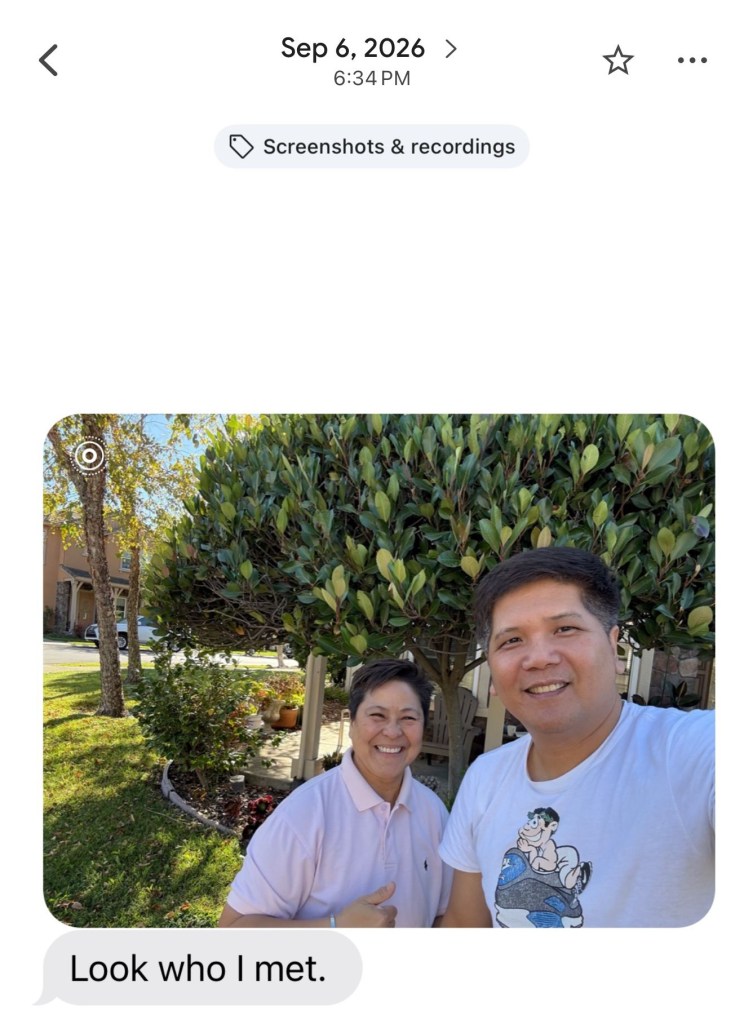
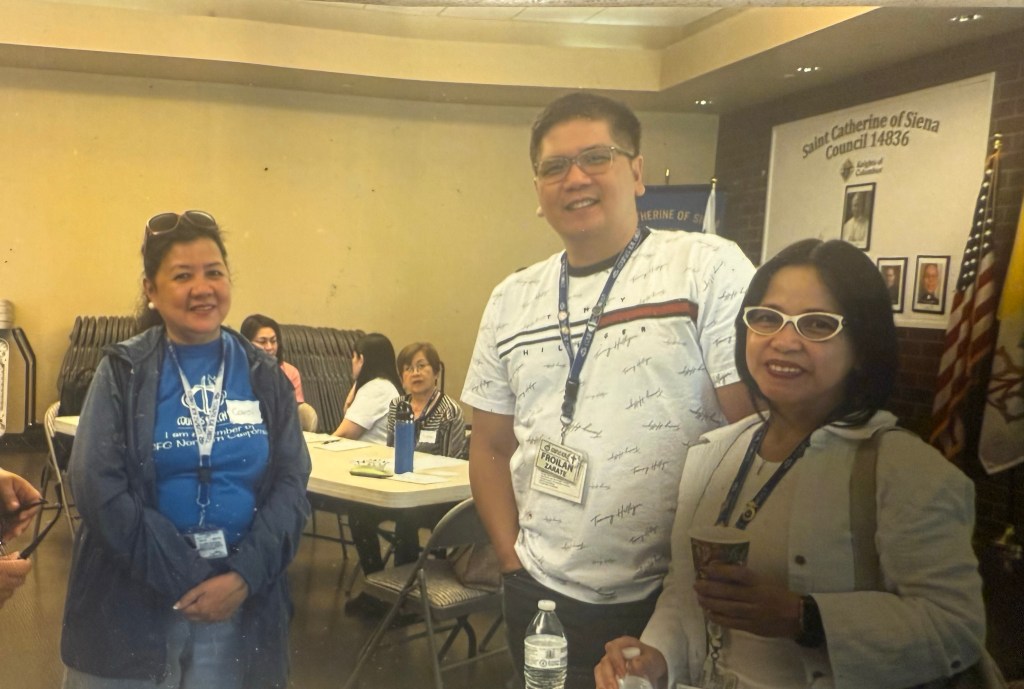
That alone made me smile. Brother Froiland and his wife, Nida, had recently said yes when they were asked to become our household leaders. My wife Carol even had a photograph with the two of them. At that time, however, I had no idea that Froiland’s name would soon come back to me in another way.
Then came September 17.
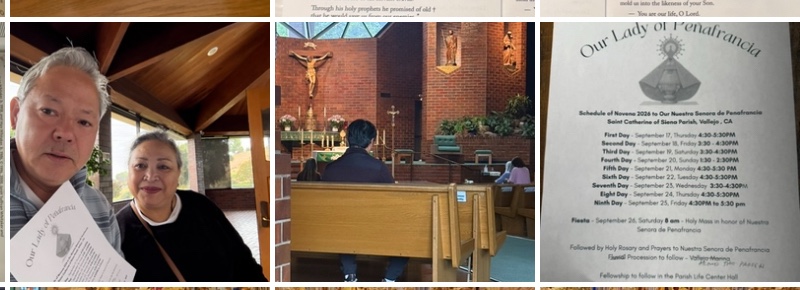
I attended Mass, and as I was leaving the church I saw Sister Lorena, who had attended our Christian Life Program before. I asked if she would like to join us for the Simbang Gabi choir. While we were talking, she showed me a flyer for the Novena to Our Lady of Peñafrancia that needed some corrections. I helped have it changed.
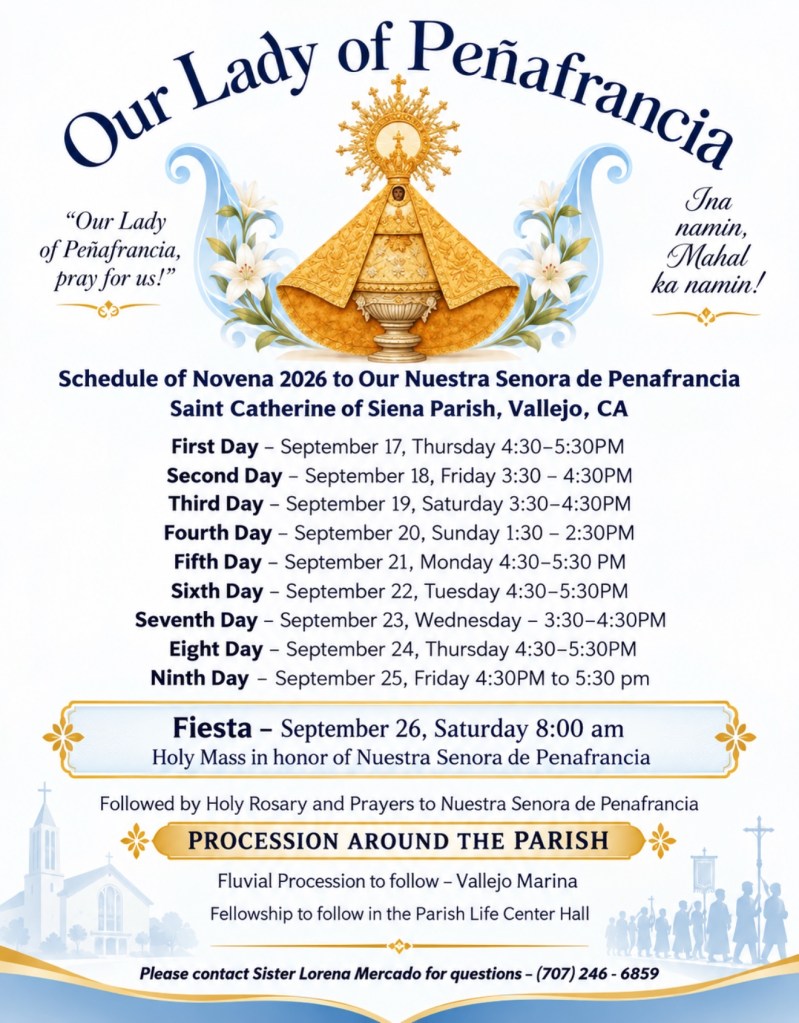
It was such an ordinary encounter. I had simply gone to Mass and was on my way out. I saw Lorena, invited her to sing, and she happened to show me a Peñafrancia flyer that needed help. For me, it was one of those Exacto moments—an ordinary event arriving at just the right time.
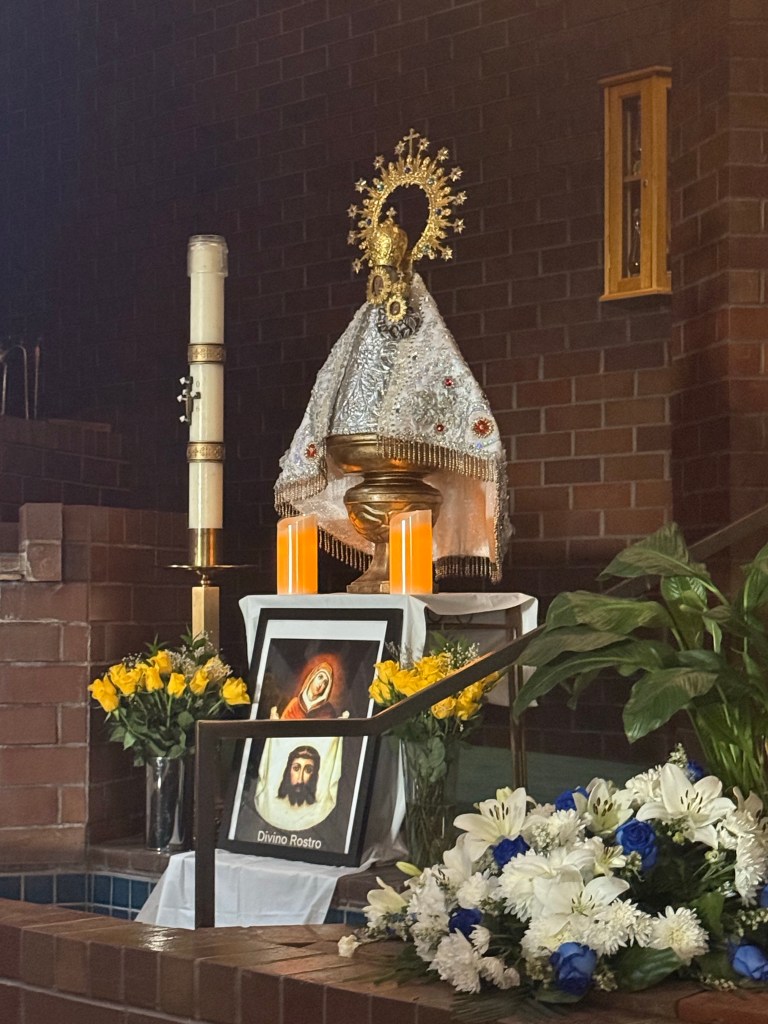
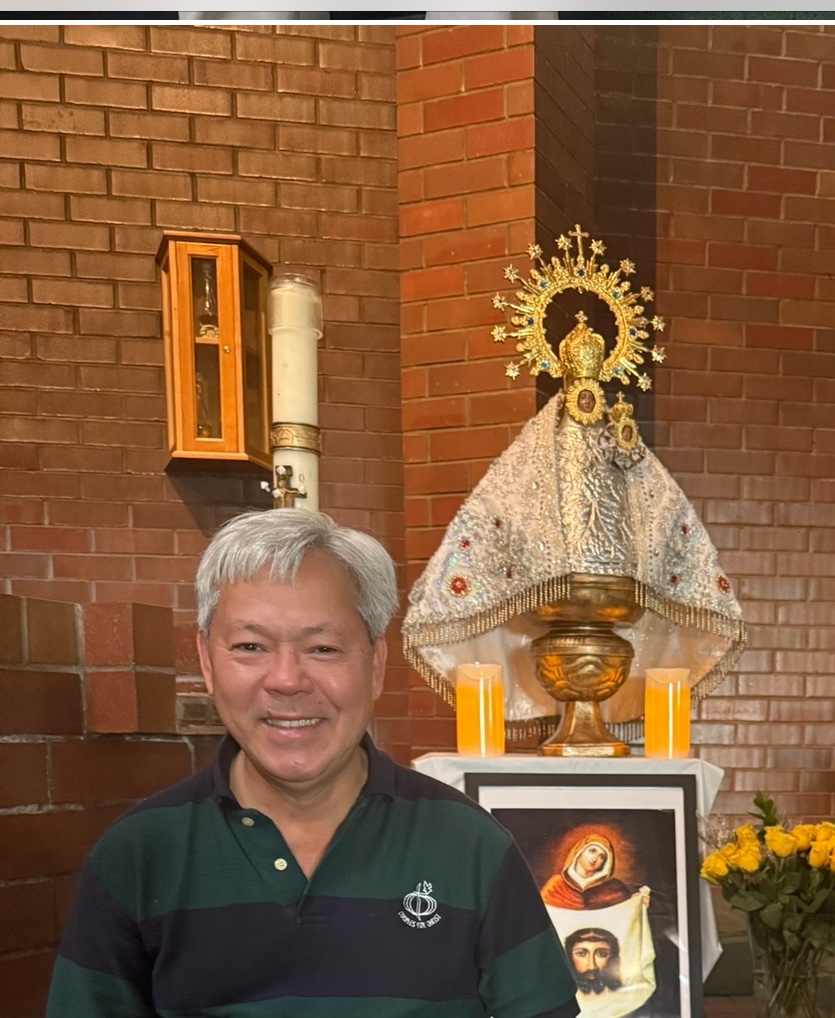
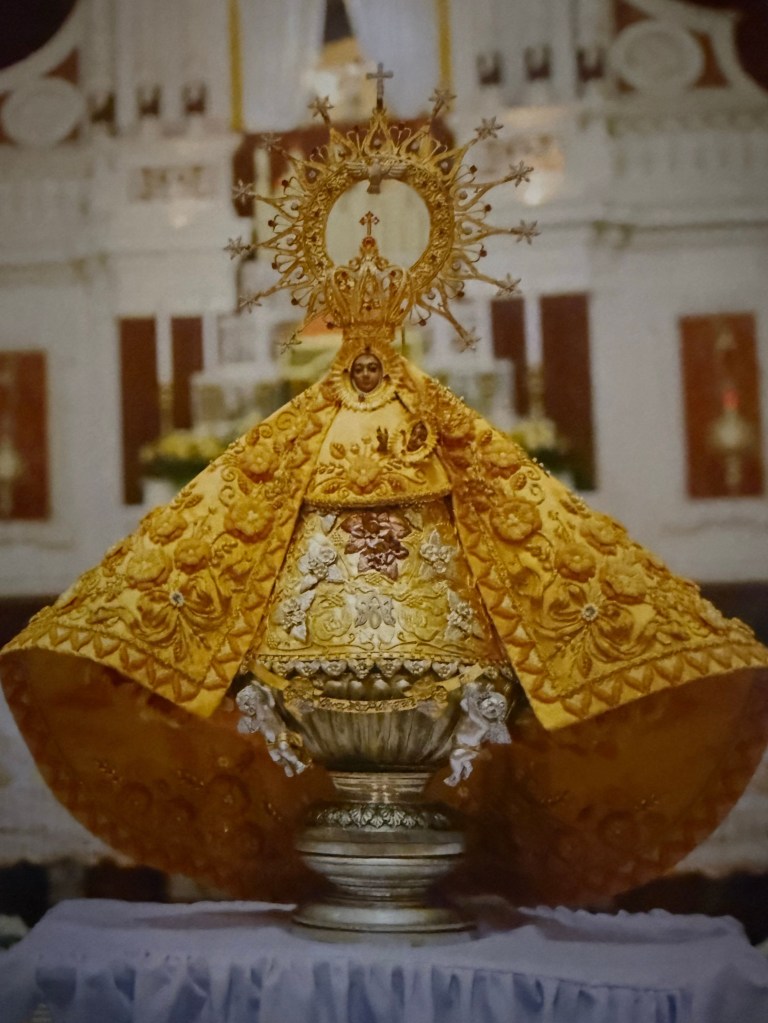
I attended the first day of the novena at St. Catherine of Siena in Vallejo. Standing before the image of Our Lady of Peñafrancia, I thought of Bicol. Then the old message from 2019 came back to me: “Bicol was changed by St. Atilano.” And again I remembered Gee’s question: “Is Atilano a saint?”
This time I searched for the answer. To my surprise, there really is a San Atilano. The Diocese of Zamora in Spain honors him as its first bishop and patron saint. As I read about his life, I discovered that his companion in prayer and mission was San Froilán.
Froilán.
I immediately thought of Brother Froiland—and I smiled again.
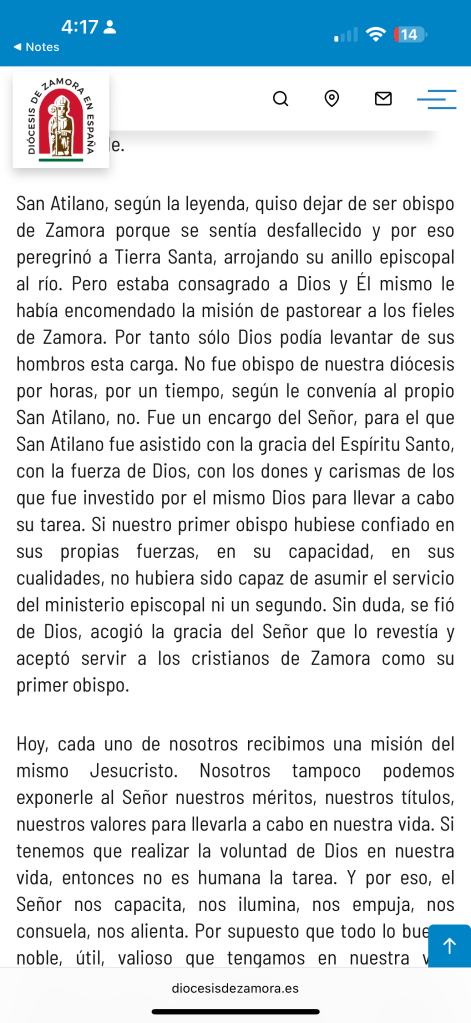
Here is the English translation of the visible Spanish text:
According to tradition, Saint Atilano wanted to cease being Bishop of Zamora because he felt discouraged. For this reason, he went on pilgrimage to the Holy Land, throwing his episcopal ring into the river.
But he had been consecrated to God, and God Himself had entrusted to him the mission of shepherding the faithful of Zamora. Therefore, only God could lift this burden from his shoulders.
He was not bishop of our diocese only for certain hours or for a period of time, whenever it suited Saint Atilano. No. It was a mission entrusted to him by the Lord.
To fulfill it, Saint Atilano was assisted by the grace of the Holy Spirit, by the strength of God, and by the gifts and charisms with which God Himself had endowed him so that he could carry out his task.
If our first bishop had trusted only in his own strength, abilities, and qualities, he would not have been capable of carrying out the service of the episcopal ministry even for a second.
Without doubt, he trusted in God, welcomed the grace of the Lord that clothed him, and accepted the call to serve the Christians of Zamora as their first bishop.
Today, each one of us receives a mission from Jesus Christ Himself.
We, too, cannot simply present to the Lord our merits, titles, or personal qualities as the means by which we will accomplish that mission in our lives.
If we are to accomplish the will of God in our lives, then the task is not merely human. And for this reason, the Lord equips us, enlightens us, urges us forward, consoles us, and encourages us.
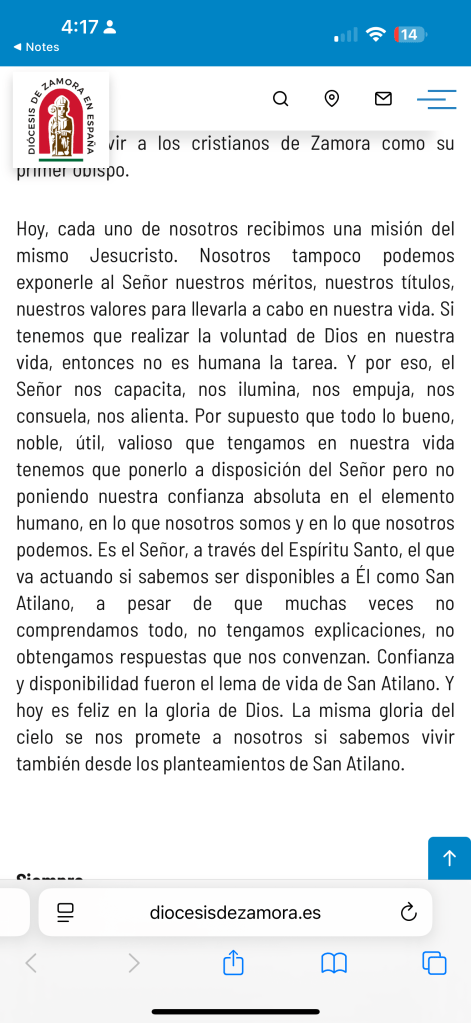
The continuation translates as:
Today, each one of us receives a mission from Jesus Christ Himself. We cannot present to the Lord our merits, our titles, or our personal qualities as the means by which we will accomplish that mission in our lives.
If we are to carry out the will of God in our lives, then the task is not merely human. For this reason, the Lord equips us, enlightens us, urges us forward, consoles us, and encourages us.
Of course, everything good, noble, useful, and valuable that we possess in our lives must be placed at the Lord’s disposal. But we must not place our absolute trust in the human element—in who we are or in what we ourselves are capable of doing.
It is the Lord, through the Holy Spirit, who acts, if we know how to make ourselves available to Him as Saint Atilano did, even though many times we may not understand everything, may have no explanations, and may not receive answers that satisfy us.
Trust and availability were the guiding principles of Saint Atilano’s life.
And today he rejoices in the glory of God. That same glory of heaven is promised to us if we also learn to live according to the principles that guided Saint Atilano.
That final paragraph is especially fitting for your story. The words from the Diocese itself are essentially “confianza y disponibilidad” — “trust and availability.”
Only days earlier, Froiland had unexpectedly met my sister, an Atilano, and sent me their picture saying, “Look who I met.” Now I was reading about San Atilano and San Froilán. And here in our own CFC community were Froiland and Nida, a couple who had just said yes to serve.
What touched me most was not the similarity of the names. In the Diocese of Zamora’s reflection on San Atilano, two words stood out to me: trust and availability.
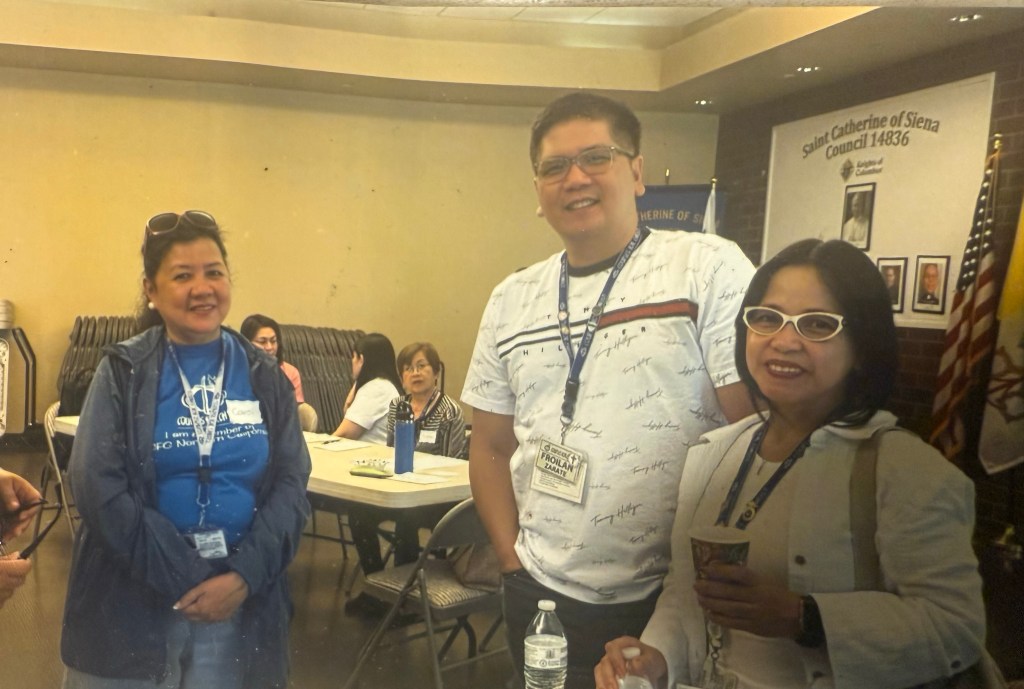
That brought the whole story back to something simple. Froiland and Nida made themselves available when our community needed household leaders. Lorena was willing to serve through music. I happened to be available when she needed help with the flyer. None of these things needed to be spectacular. They were ordinary moments of people simply saying yes.
I cannot explain every connection, and I do not want to force one. I have no evidence that San Atilano had a historical connection with Bicol, and I cannot say that the events were supernatural signs. I can only tell the story as it happened.
An old message led me back to Bicol. Peñafrancia led me back to the question about San Atilano. San Atilano led me to San Froilán. And the name Froilán made me think of Brother Froiland, who with Nida had already answered a call to serve.
It simply made me smile.
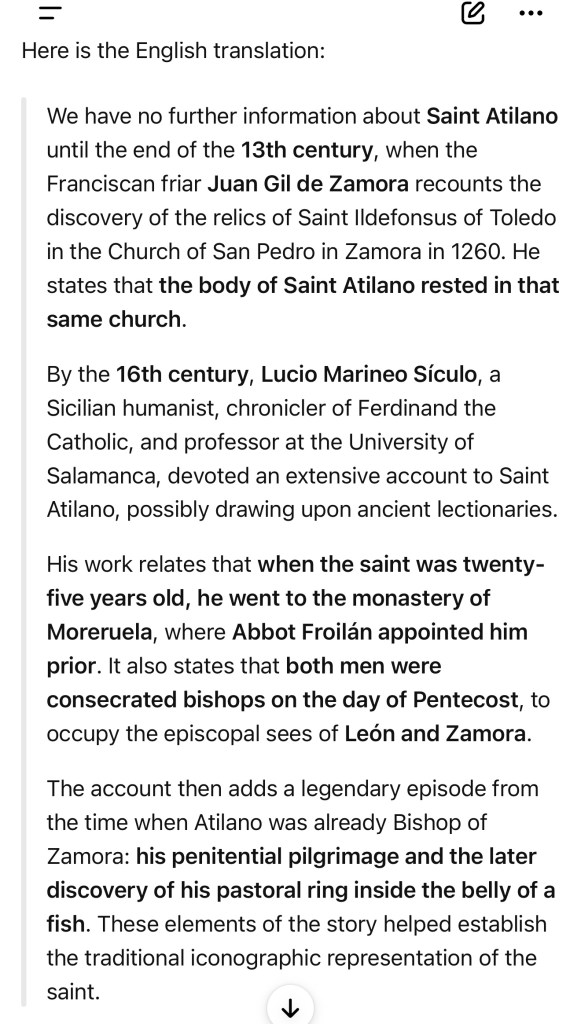
Here is the English translation:
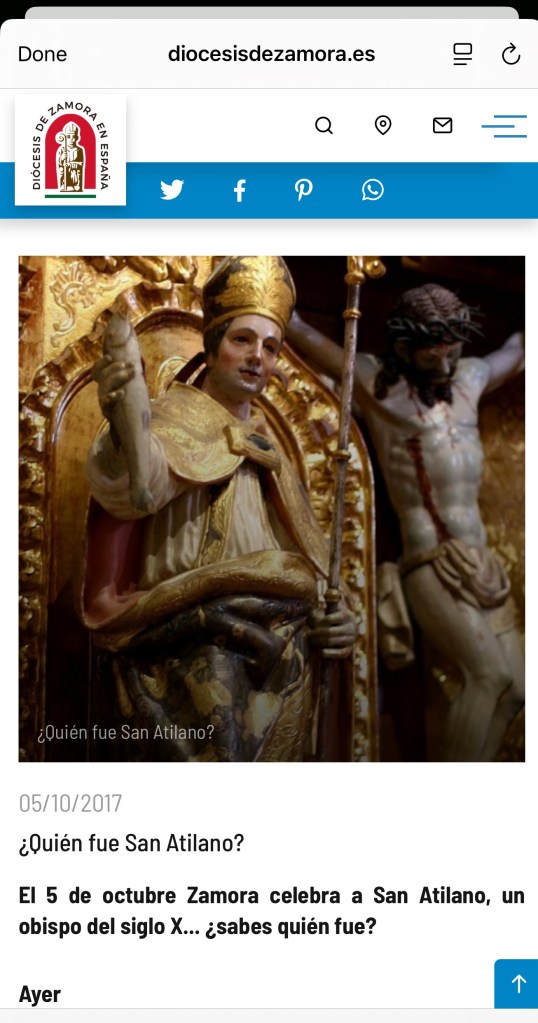
We have no further information about Saint Atilano until the end of the 13th century, when the Franciscan friar Juan Gil de Zamora recounts the discovery of the relics of Saint Ildefonsus of Toledo in the Church of San Pedro in Zamora in 1260. He states that the body of Saint Atilano rested in that same church.
By the 16th century, Lucio Marineo Sículo, a Sicilian humanist, chronicler of Ferdinand the Catholic, and professor at the University of Salamanca, devoted an extensive account to Saint Atilano, possibly drawing upon ancient lectionaries.
His work relates that when the saint was twenty-five years old, he went to the monastery of Moreruela, where Abbot Froilán appointed him prior. It also states that both men were consecrated bishops on the day of Pentecost, to occupy the episcopal sees of León and Zamora.
The account then adds a legendary episode from the time when Atilano was already Bishop of Zamora: his penitential pilgrimage and the later discovery of his pastoral ring inside the belly of a fish. These elements of the story helped establish the traditional iconographic representation of the saint.

Maybe that is enough. Sometimes the little details of life do not need an explanation. They simply make us stop, remember, and turn our hearts toward God.
Thank You, Lord. Teach me to trust You, and when You call me, help me to be available.
Our Lady of Peñafrancia, pray for us.
San Atilano, pray for us.
San Froilán, pray for us.
Come, Holy Spirit. Help us to say yes.
Kwento lang ito.
I am simply sharing what happened.
I smiled when I discovered that there really was a San Atilano, and that his story was closely connected with San Froilán. I smiled even more because of what had happened with Brother Froiland, my sister, Lorena, Peñafrancia, and CFC.
But I don’t want to make myself the center of the story.
Yesterday the priest reminded us about the danger of vainglory—when something that should lead us to God begins instead to draw attention to ourselves.
So I leave this simply as a story.
Maybe there is a meaning in all these little connections. Maybe some of them are simply coincidences. I don’t need to decide.
What stays with me are the words I found in the story of San Atilano:
Trust and availability.
To trust God. To remain available. To serve when called.
The glory belongs to God.
Kwento lang ito—and it made me smile.


Leave a comment